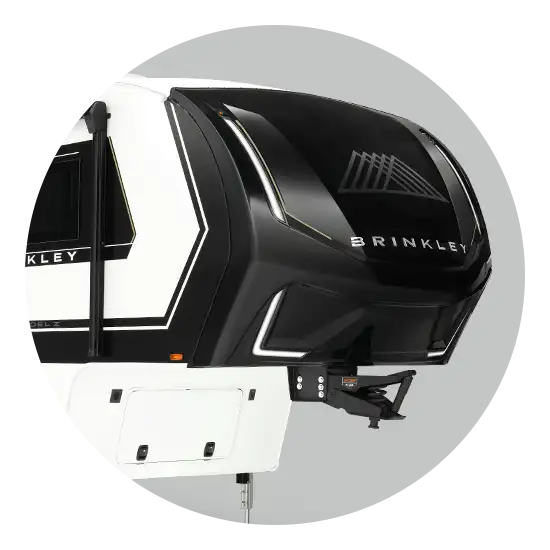
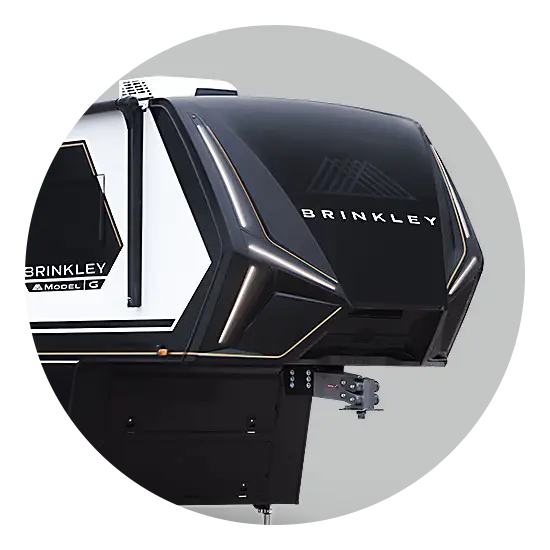
Wall cracks have shown up in a small percentage of our 5th wheels overall. It was most prevalent in early 2024 model-year units.
On affected units, a wall crack typically appears near the top or bottom of the slide-out corner in the bedroom, where the stress is highest.
We build our frames and structure to be extremely rigid, and that rigidity was intentional, to combat the bigger issue of the dreaded ‘frame flex’.
Due to the rigidity of the chassis, additional stress is transferred into the sidewalls.
It is typically located in a slide-out opening corner, where the stress is highly concentrated. If the stress localizes there, it can begin to loosen the bond between the aluminum and the fiberglass, potentially causing a crack in the glass or in the interior paneling. In certain cases, this adhesion failure can transfer into the aluminum structure, possibly leading to cracked welds. On a positive note, the entirety of the wall structure itself, is not compromised.
Our repair addresses exactly that. It reinforces the wall’s structure to distribute those stresses more evenly, so the movement is no longer focused on one particular location. The affected wall area is then restored to its proper finished condition.
Where the design stands now
We have made significant improvements to the way the sidewalls of our units are designed and built. Because different floorplans carry and distribute stress differently, these improvements are tailored to each model and floorplan, rather than relying on a one-size-fits-all solution.
The changes have been introduced over time and, where applicable, incorporated into each design.
Depending on the model and floorplan, updates have included but are not limited to:
Suspension system changes (Model Z)
Changes to the adhesive used in the sidewall lamination process
Additional preparation to the aluminum structure (scuffing/alodine application) before the lamination process to dramatically improve the bond
Changes to the fiberglass supplier used in the sidewalls
Additional fastening beneath the gooseneck area (spax screws)
Larger fasteners at key wall-to-chassis attachment points
Improved sidewall setting process with pre-loading and leveling
Added custom L-bracket reinforcements around bedroom slide-out openings to support welded joints
Added hurricane straps in multiple areas to reinforce the joints
Added radiused corner reinforcement around non-bedroom slide-out openings to help distribute concentrated stress
Added additional Upper-deck outriggers
Added composite reinforcement within hollow structural areas to prevent wood splitting
Added Larger upper-deck gussets in sidewall framing
Additional straps and brackets around bedroom slide-out openings to strengthen and distribute loads
We validate these changes through advanced computer modeling (FEA) and professional durability testing (3rdParty Automotive Proving Grounds). Additionally, we monitor each floorplan on how they perform in real-world use over time.
We are confident that these engineering and manufacturing changes address the root cause.
We are seeing the results reflected in our field data. On the Model Z, the wall crack incidence rate decreased 78% from model year 2024 to 2025, followed by a further 99.9% decrease from model year 2025 to 2026. On the Model G, the incidence rate decreased 59% from model year 2024 to 2025 and another 87% from model year 2025 to 2026.
Long-term real-world data will confirm our conclusion. We will continue to share what we learn as real-world data further validates our computer modeling and test track data.
We remain committed to our core values, continuous product improvement, and transparency with our Brinkley family throughout this process.
If your RV has a crack
Here is what to do, at a glance:
Reach out to Customer Care by phone at 574-501-4280 or through our online contact form, Monday through Friday, 8 AM to 5 PM Eastern Time.
A Care Team representative will ask for photos of the area so we can assess it and plan the right repair for you.
Your representative will share our specially trained repair locations, and you will choose the location and date that fit your schedule.
Once work begins, the repair typically takes about three weeks. You can keep using your RV until your scheduled repair.
Note: Unless our team provides specific instructions for your situation, do not attempt to repair, seal, fill, drill, or otherwise modify the cracked area before it can be evaluated.
Click to Expand.
What to do, step by step
If you think you may have a crack, please reach out to our Customer Care team by phone or through our online contact form. A Care Team representative will ask you to submit photos for review so we can assess the issue and determine the best action plan for you. Please send photos of the area of concern and be as specific as possible about the exact location.
Once the photos are received and reviewed, the Care Team representative will provide you with a list of locations across the country that have been specially trained to complete this repair. From there, you’ll work together to find a location and appointment date that best fits your schedule and availability. This process takes approximately 1-3 business days once the photos are received.
What to watch for early
Often the first sign is the exterior trim piece near the slide working loose. If you see that the trim piece has come loose, and the wall sections on both sides of the trim piece are uneven, reach out, and we will take a look.
Is it safe to keep using your RV in the meantime?
A wall crack does not affect your RV’s overall structural integrity or how it tows and drives, and to date, it has not caused a functional or slide-out failure. You can keep using your RV until your scheduled repair. If anything changes or you have a new concern, contact Customer Care.
The repair: what happens and how long
The Repair: What Actually Happens
The repair involves removing and replacing a portion of the affected sidewall so our team can access, inspect, and reinforce the framing behind it to properly distribute the load. Specifically, we remove the exterior skin from the affected area of the sidewall, remove insulation as necessary, and inspect the internal wall structure, including welds, for any related damage. Additional aluminum supports are added in these areas to further strengthen and distribute the load against future stresses. Finally, a new exterior skin is installed, the seam above the main slide is professionally finished and painted to match, and all components, trim, and graphics are reinstalled.
How Long Does the Repair Take?
Because this repair involves welding, body work, paint application, and required curing times, the repair process typically takes approximately three weeks once work begins. This timeframe does not include the initial check-in inspection, final quality inspections, pre-delivery inspection, or any additional unrelated repairs that may be identified during the service process. Note that units with full-body paint will require additional time. Please contact Customer Care for further details.
Brinkley has invested heavily in our factory service facilities and staffing, growing the factory service team more than tenfold over the past two years. That growth is ongoing. We will continue adding to the team to back our commitment to standing behind our product and completing repairs as quickly as we can without compromising the quality of the work.
We are also focused on identifying efficiencies that will reduce the repair times and minimize the inconvenience to our customers. Part of that effort includes expanding our trained dealer partner network so customers have more locations across the country where repairs can be performed.
Quality and effectiveness come first. As we continue growing our service capacity and repair network, our goal is to make the process as efficient and accessible as possible while ensuring repairs are completed to the level of quality our owners expect from Brinkley.
Where Is the Repair Performed?
Repairs are completed by trained Brinkley technicians and authorized wall repair partners who follow Brinkley-approved repair procedures and quality standards. These authorized wall repair partners are strategically located throughout the country and receive hands-on training from Brinkley on the repair process. We have a team of technicians who travel full-time to dealer locations to ensure that the work is being performed using the same processes and standards followed in our Factory Service Center. Our team works closely with these facilities throughout the repair process to ensure consistency, quality, and adherence to our repair specifications.
What about Canadian owners?
At this time, we do not have a wall crack repair partner in Canada. Canadian owners will need to bring their RV to an approved repair location in the United States for this repair. Customer Care will work with you to identify the available U.S. repair options that make the most sense for your location.
Can I get my other warranty items fixed while it’s already in for the wall repair?
We encourage owners to address routine or unrelated warranty items through their Brinkley dealer or a qualified mobile technician as they arise rather than waiting for a wall crack appointment. This can often get simpler concerns resolved sooner and helps keep your factory service visit focused on the work that requires our facility.
If you do have other concerns you would like considered during your wall crack repair, please let us know before your service appointment. Our team will review them and determine what can reasonably be completed during your visit.
Because appointments are scheduled around the work identified in advance, we may not be able to accommodate additional service requests presented at drop-off.
If a crack comes back, or something new shows up after repair
A very small percentage of owners have found a new issue after repair or had a crack return. We take that seriously, and here is how we handle it:
After-repair issues
We take great care to ensure that your unit is returned to you in peak condition, including a comprehensive inspection of the repairs done and a complete systems check of the unit. It is very unlikely that you will find repair-related issues after your service visit, but we have you covered if you do.
Your Service Advisor is your contact until your RV is back in your hands. After pickup, contact Customer Care for anything related to your repair, whether it shows up the first day or months later. They’ll open a case, bring in the Service Advisor who handled your repair, and find the most convenient solution, which may mean a mobile technician, a dealer partner, or occasionally a return visit to us.
Repeat cracks
As we have refined our repair process, the rate of recurring failures has continued to diminish. If you are one of the few customers who may experience a recurring crack, please reach out to our Customer Care team. We understand how frustrating this can be, and we’re here to help. Once we hear from you and get additional details, we will work with you to develop an action plan that best fits your needs within 1-3 business days.
Reaching us, and what to expect
We made a few changes on our end that unintentionally slowed our replies, and some of you waited too long for a response. We’re sorry. That is not the experience we want. We’ve addressed it, and we’re back on track. Our standard is to respond to every inquiry within 2 business days.
We do read what you share online, and that feedback helps shape how we build. When you need help with your RV, though, Customer Care is the most direct path. They can open a case, review your photos, and get you scheduled.
How to reach us
The Brinkley Customer Care Team is available Monday through Friday, 8 AM to 5 PM Eastern Time, by phone at 574-501-4280 or through our online contact form.
We are closed on the following holidays: New Year’s Eve and New Year’s Day, Memorial Day, Fourth of July, Labor Day, Thanksgiving and Black Friday, Christmas Eve and Christmas Day. During key holiday closures, a Brinkley Emergency Helpline is available to ensure owners still have a resource for urgent situations while our Customer Care team is closed.
The helpline is only active during designated holiday timeframes, including the corresponding weekend when applicable, and is intended for emergencies when a Brinkley dealer or mobile technician is unavailable. The Brinkley Emergency Helpline phone number is 844-782-7465.
What to expect
Our Customer Care Team is here to help, with timely, accurate, and personalized support. Each inquiry is reviewed individually so we fully understand your situation and can give you the right guidance. Depending on your concern, we may need to gather more information or coordinate with a dealer, service provider, or other Brinkley teams before giving you a complete answer. We know how important your RV is to you. Throughout the process, we’ll keep you informed and help you find the best path forward.
answers to your most common questions about wall cracks (FAQ)
Click to Expand.
Are wall cracks happening to every Brinkley RV?
No. It has only shown up on some of our fifth wheels, with Model G most affected and Model Z less so. We have not seen this trend in our Model I, Model Ix, or Model Z AIR travel trailers.
Was this answer helpful?
What causes the wall’s fiberglass to crack on some units?
We build our chassis to be extremely rigid. That was intentional, to combat frame flex. Every structure has a little give, and because of the rigidity of our chassis, that small amount of movement is transferred to the sidewall. It typically concentrates near the top or bottom corner of the bedroom slide-out opening, where the aluminum wall framing bonds to the exterior fiberglass. Over time, that focused stress can loosen the bond at that spot and crack the fiberglass skin, and sometimes the nearby interior paneling.
It is not caused by normal use within your RV’s weight ratings and designed limits. Our repair reinforces the wall to distribute that stress more evenly, and our production changes address the wall, its bond, and its attachment to the chassis.
Was this answer helpful?
Is the wall crack caused by frame flex?
No. These wall cracks and ‘frame flex’ are two different things in two different parts of the RV. The wall crack is part of the wall itself, where the aluminum wall framing meets the exterior fiberglass. Frame flex is about the chassis, the steel frame your RV is built on. In towable RVs, “frame flex” typically describes the chassis bending, twisting, or racking under load beyond its intended design. Every steel frame moves to some degree by design, and that part is normal. It becomes a problem only when the amount or repetition of that movement exceeds what the attached structure can handle. That is not what is happening with these wall cracks, and we have seen no instances related to frame flex on our units.
Was this answer helpful?
How does weight affect wall cracks?
Loading your rig within its weight ratings does not cause wall cracks. Staying within your rig’s rated weights is not only safer, but is also easier on your tires, brakes, tow vehicle, and overall structure. Overloading is a different matter: results from our real-world durability track testing show that overloading the unit beyond the GVWR, compared to staying within the stated capacity, increases the likelihood of a wall crack.
Was this answer helpful?
Can I still travel while I wait for my wall crack repair?
Yes. The cracks we have seen do not affect your RV’s overall structural integrity or how it tows and drives. You can keep using and traveling in your RV as planned until your scheduled appointment. If you have any concerns, please contact Customer Care.
Was this answer helpful?
Is there a specific date when the wall crack issue was fixed?
There is no single cutoff date or VIN, and that is a function of how we work. These improvements are continuous, and we tailor them by model line and floorplan. The improvements span everything from changes to the sidewall lamination process and materials to fastening methods, slide-out reinforcement, suspension, upper-deck structure, and additional reinforcement in key stress areas.
Here is where we stand: two of the three measures we hold ourselves to already back our updated builds. First, our computer modeling (FEA) gives us strong confidence in the changes. Second, the updated designs have successfully completed several full-unit durability tests at independent testing facilities used by the automotive, commercial trucking, and transportation industries.
Lastly, time in the real world. We as a company feel extremely confident in what we are building and will continue to stand behind our belief that the problem is behind us. Situations out of our control, such as overloading the unit beyond the GVWR, road hazard impact/collision, and traveling at high speeds can increase the likelihood of failure.
Was this answer helpful?
How long does a wall crack repair on a Brinkley take?
The wall-crack repair itself typically takes about three weeks once repair work begins. The total time your RV is at the repair location may be longer based on appointment availability, check-in and final inspections, full-body paint and curing requirements, and any additional service work being completed during the visit.
After Customer Care receives and reviews your photos, we will typically respond with repair-location options within 1 to 3 business days. This is the timeframe for receiving your repair options, not the timeframe for the repair appointment itself. Appointment availability and total service timelines vary by location.
Was this answer helpful?
What happens if my warranty expires while I’m waiting for the appointment?
You’re still covered. If you sent us photos of the crack while your RV was still under warranty, the repair is covered even if the warranty period ends before your appointment. What matters is when you reported the crack, not when the repair is scheduled. Keep your Customer Care case number. It’s your record of when you reported it.
Was this answer helpful?
What factors can affect how long a wall crack repair takes?
The total time your RV is away can vary based on appointment availability, whether the unit has full-body paint, paint and curing time, initial and final inspections, and any additional service work done during the same visit. The wall-crack repair itself typically takes about three weeks once work begins. Customer Care can provide you with the most current estimate for your unit and repair location.
Was this answer helpful?
Does the owner pay anything?
No. If the wall crack is determined to be consistent with our findings and caused by a defect, Brinkley will cover the wall crack repair at no cost to the owner.
This coverage applies to the repair itself. Owners are generally responsible for other expenses associated with getting the RV to and from the repair location or being without the RV during service, such as transportation, travel, or accommodations.
Was this answer helpful?
Will a warranty repair hurt my RV’s resale or trade-in value?
Brinkley does not control how the market values an individual used RV. Resale or trade-in value can be affected by many factors, including the unit’s condition, maintenance history, documentation, and the market value of that make and model at the time of sale or trade.
What we can control is how the issue is addressed. A wall crack repair completed through Brinkley’s approved repair process corrects the identified issue and restores the affected area using our established repair procedures.
When your repair is completed, you’ll receive a work order documenting the repair performed. Keep this with your service records so a future dealer or buyer can see exactly what was addressed and that the repair was completed through the proper process.
Was this answer helpful?
I have questions about wall cracks, who should I ask?
If you already own a Brinkley and have a question about a crack, a repair, or your warranty coverage, contact our Customer Care team at 574-501-4280 or through our online contact form, Monday through Friday, 8 AM to 5 PM Eastern time. If you are considering a Brinkley and want to talk through anything on this page before you buy, our Sales team is glad to help at (574) 501-4285 or through our online contact form.
Was this answer helpful?
Is there anything I can do to minimize the chance of having a wall crack?
Your Brinkley is engineered for real-world roads and normal use within its designed weight and towing limits. A wall crack that develops under those conditions is our responsibility to address. At the same time, how any RV is loaded and operated affects the stresses placed on its structure. Following these practices can help minimize unnecessary stress and are important for the overall life and performance of your RV:
Stay within your RV’s weight ratings and distribute weight properly. Exceeding the GVWR or other applicable weight ratings, or significantly improper weight distribution, can place stresses on the RV that it was not designed to handle.
Slow down on rough or poorly maintained roads. Reducing speed helps limit the forces transferred through the RV structure.
Use an appropriately matched tow vehicle. Tow vehicles with significantly stiffer suspension, such as some commercial vehicles, can transfer greater forces into the RV structure.
Extreme events and use outside the RV’s designed limits are different from normal operation. High-speed impacts, leaving the roadway at speed, significant overloading, or other extreme conditions may contribute to damage and are reviewed on a case-by-case basis.
Was this answer helpful?
We will keep this page up to date. If your question is not answered here, reach out, and we will help, and we will likely add your question to this page, so the next owner has it too.